See how school districts across Louisiana are partnering with Code4Kids to move past simple mandate compliance. Read our partner stories to discover how local educators are building strong K-8 foundations, measuring real student learning, and driving true high school readiness.
"Code4Kids is proving very effective for our students, our computer science curriculum, and state initiatives. Our students are engaged, challenged, and ready for 21st-century careers and lifelong learning!"
— Middle School CS Teacher, Bossier Parish Schools
How Bossier Parish Schools built a standards-aligned CS program from scratch, measured what students were actually learning, and used that data to build the K-8 foundation that makes high school and career readiness possible.
Every state that passes a Computer Science mandate solves the same first problem: getting standards aligned courses on the instructional schedule. What most districts don't yet know is whether those courses are building students who can break down complex problems, write real code, and apply what they've learned to challenges they've never seen before - or just students who completed the required course. Here’s what happened when Bossier Parish Schools decided to find out.
Key Findings
Bossier Parish Schools entered the 2025-26 school year with something they hadn't had before: a fully standards-aligned Computer Science curriculum across all seven middle schools, mapped to Louisiana's five CS content areas, with teachers trained to deliver it - many of whom had never taught the subject before. No shared curriculum, standards alignment, or data on what students knew had existed before. The baseline benchmark changed all of that. Here is what it revealed.
Finding 1: For the First Time, the District Could See What Students Were Learning - and Where They Weren't
Bossier Parish gained a complete picture of CS proficiency across all seven middle schools - by school and by content area. Before the benchmark, the district had no way to know where students were strong, where they were behind, what prior exposure they had received, or whether what was being taught was actually landing. That visibility is what made every decision that followed possible.
Finding 2: Proficiency Varied Widely Across Schools. A District Average Would Have Hidden All of It
The share of students exceeding grade-level expectations ranged from 93% at the district's highest-performing school to 38% at its lowest despite both schools being in the same district and teaching the same standards. Without school-level data, that gap was invisible. The district had no basis for directing support differently across schools, because it had no way of knowing that differentiated support was needed.
Finding 3: The Data Pointed to a K-8 Solution, Not Just a Secondary School Fix
The areas where students struggled most - applied coding, logical problem-solving, understanding how hardware and software work - are the same skills that determine whether a student arrives in high school ready for CS or already lacking confidence before the course begins. Those gaps were largest in 6th grade, pointing directly to what wasn't being built before middle school. Better middle school instruction was part of the answer. Creating a strong K-8 foundation was the bigger one.
Before the Mandate, There Was No Common Starting Point
Before a CS mandate exists, most districts are in the same position. Computer science instruction happens wherever individual teachers choose to make it happen - a handful of classrooms here and there, dependent entirely on personal interest, with no common curriculum, shared standards, and no way to measure what students are learning. Bossier Parish was no different.
The mandate changed that. Starting with the 2026-27 school year, every middle school in Louisiana is required to offer a standards-aligned CS course, and every freshman entering high school must complete one to graduate.
For Bossier Parish, that meant building a program where none had existed. The district partnered with Code4Kids to develop a vertically aligned middle school CS curriculum mapped to Louisiana's five CS content areas across all grade levels: Algorithms and Programming, Impacts of Computing, Computing Systems, Networks and the Internet, and Data and Analysis. Teachers were trained to deliver it and by the start of the 2025-26 school year, all seven middle schools had a coherent, standards-aligned program in place.
Rather than starting with the high school graduation requirement and working backwards, Doug Scott, who oversees CTE and computer science, decided to start with laying a strong foundation in middle school. Why? Because he had the foresight to know that a student who arrives in high school without the underlying skills isn't ready for a CS course regardless of whether it's on their schedule.
Then came the question that no mandate answers on its own: were students actually learning?
Getting courses on a schedule satisfies a compliance requirement. It doesn't tell you which schools are building real understanding and confidence, where the gaps are, or what any of it means for students heading toward a high school graduation requirement. In the Fall of 2025, Code4Kids’ Baseline Benchmarking was rolled out across all seven middle schools. For the first time in the district's history, they had real data to work from.
.png)
The 55-point gap across schools
District-wide, 70% of students performed above grade-level expectations. On its own that number looks more than fine. But a single average across seven schools tells a district almost nothing it can act on. The share of students exceeding grade-level expectations ranged from 93% at the district's highest-performing school to 38% at its lowest - both teaching the same new standards and using the same curriculum for the first time. Without that school-level picture, students at the lowest-performing schools would have received the same support as everyone else, their gaps unidentified and unaddressed, while the district operated under the impression that 70% above grade level meant things were broadly on track.
Where the foundational gaps were
Students performed strongest in digital citizenship, responsible technology use, and working with data - areas with more natural connection to everyday technology use where students tend to arrive with some prior informal exposure. The weakest areas were applied coding, logical problem-solving, and understanding how hardware and software work together - the durable skills that determine whether rigorous high school CS coursework is accessible or out of reach. Proficiency in these areas averaged in the low-to-mid 60s in 6th grade. Gaps here don't resolve on their own. They follow students forward.
What the grade progression showed
Average proficiency climbed from 67% in 6th grade to 78% in 8th. The prior exposure students bring into middle school shapes what they're capable of achieving there. This has led to plans to deepen and strengthen the foundation even further into the elementary grade bands.
Students are interested in the subject but most don't yet feel ready
Across all seven schools, student interest in pursuing the subject in high school consistently outpaced confidence in succeeding. Students already see computer science as relevant to their futures. What they lack is the belief that they can do it. Without earlier and more consistent CS instruction, that confidence gap follows students into high school where it becomes a career pathway problem. Students who could have pursued advanced CTE pathways, and careers in a field they were genuinely interested in opt out - not because the interest wasn't there, but because nothing built the confidence to match it.
"Before implementing the benchmarking assessments, computer science was happening in pockets across our middle schools, but we didn't have a consistent way to understand how students were progressing or where support was needed. Having a district-wide baseline and ongoing benchmarking data has given us much greater visibility into how learning is developing across schools and how we can better support both teachers and students as we continue building our computer science pathway."
— Doug Scott, CTE Supervisor for Bossier Parish Schools
What the District Did With These Insights
The baseline gave Bossier Parish something it had never had: specific, actionable information about where students were, broken down by school and by content area.
For schools where the majority of students were in the emerging and expected tiers, Code4Kids directed additional support toward computing systems and programming fundamentals. For schools where most students were already exceeding expectations, the instructional focus shifted to extension and cross-content application.
Every teacher received an individual class-level report showing how their students performed across each content area. Where gaps were significant, Code4Kids provided targeted lesson guidance - pointing teachers to the specific content where their students needed the most work, and offering professional development tied to those areas. Support and PD was highly personalized and tailored to each individual teacher and school context.
Why the K-8 Foundation Matters
The grade progression data pointed to something districts with a middle and high school mandate often miss: the gaps showing up in 6th grade didn't start in 6th grade. Students who arrived with stronger prior exposure consistently outperformed those without it, across every content area. What is possible in middle school is shaped by the preparation students bring with them from elementary school. What is possible in high school is shaped by what was built in K-8.
Building on what the data showed, Bossier Parish is continuing to work with Code4Kids to extend CS instruction into K-5. But the more immediate proof is already in front of the district. The students entering Bossier Parish high schools in 2026-27 - the first cohort required to complete a standards-aligned CS course to graduate - will arrive having spent a full year in a structured, standards-aligned CS program.
Their teachers had specific, class-level insights on where each student was at and targeted guidance to support them. And the district had the benchmark data to make informed decisions throughout the year rather than guessing. Those students are more prepared for what high school CS asks of them than they would have been without any of that.
For Any District Asking Whether Computer Science Instruction Is Moving the Needle
Whether a Computer Science mandate exists in your state or not, the underlying question is the same: are students actually building the skills that will matter, like applied coding, logical problem-solving, the ability to understand and work with the digital systems shaping their lives? Most districts don't yet have a reliable way to answer that. Courses get scheduled, instruction happens, and the assumption is that learning follows. Sometimes it does. But often the picture is more uneven than anyone knows and unlike Math or ELA, computer science rarely gets the measurement infrastructure that would make those gaps visible.
Any district can build what Bossier Parish built. The standards-aligned curriculum, the benchmarking, the teacher-level reporting, the K-5 pathway - all of it starts with two questions: what are our students actually learning, and do we have the foundations in place to ensure they enter high school with real preparation and confidence? If you don't yet have clear answers to those, that's where we start.
About Code4Kids
Code4Kids provides K-8 computer science and AI literacy curriculum and benchmarking services for school districts. Most CS providers are built for high school. Code4Kids is built for K-8 - the developmental window that determines what students are capable of when they get there. Our curriculum and assessments are designed for teachers who have never taught CS before, giving every teacher the structure and confidence to deliver it well regardless of their prior experience.
In Louisiana, effective K–8 Computer Science instruction is essential for preparing students for the future. This is where Code4Kids makes it simple for teachers, even those with no prior CS experience. Our curriculum is fully aligned to the Louisiana K–12 Computer Science Standards, giving educators the support, resources, and confidence they need to succeed.
The first step is choosing the right starting point for your learners. Successful CS implementation often rolls out over two to three years, and no one knows your students better than you. That’s why Code4Kids offers a flexible, structured curriculum that adapts to your school’s context, ensuring steady progression at a pace that works for your classrooms.
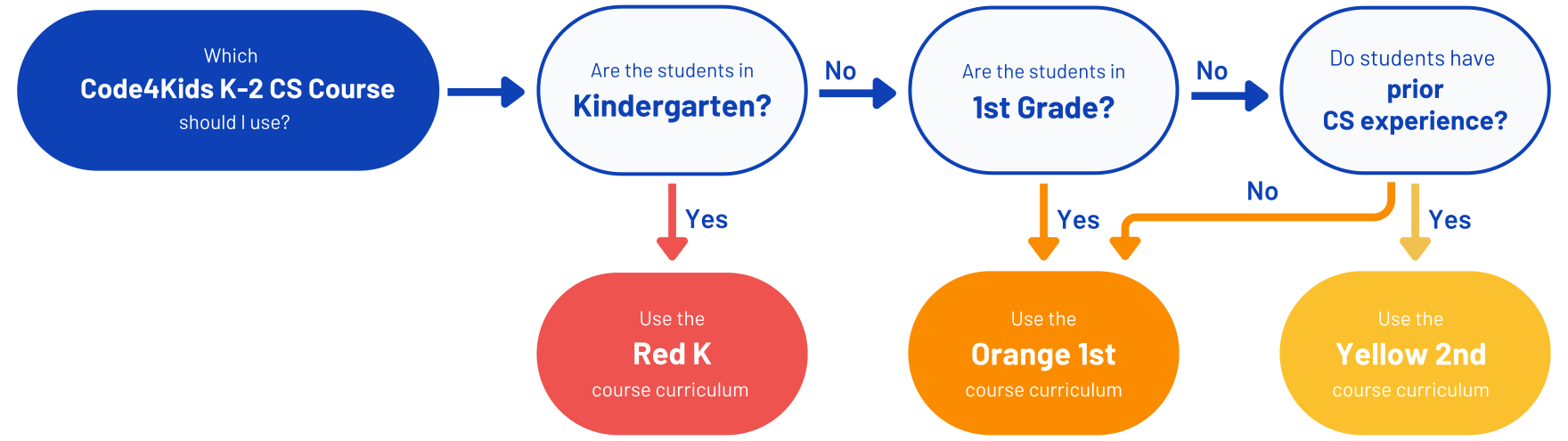
Focus on sparking curiosity and introducing the building blocks of computer science through playful, age-appropriate activities. Simply begin at the grade that best matches your students’ needs - courses are flexible, with no strict prerequisites, and grade-level suggestions are a recommended starting point only.
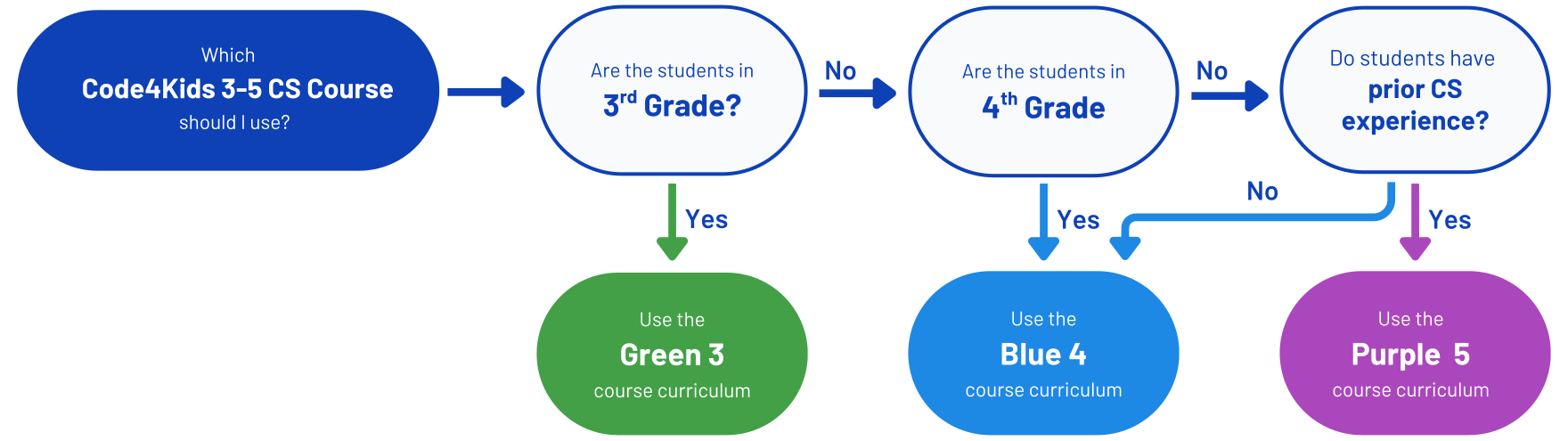
In Upper Elementary, we emphasise applying foundational skills to create programs, explore data, and develop problem-solving strategies. Build on earlier foundations or start fresh at the grade level that suits your learners, progressing at a pace that works for your school.
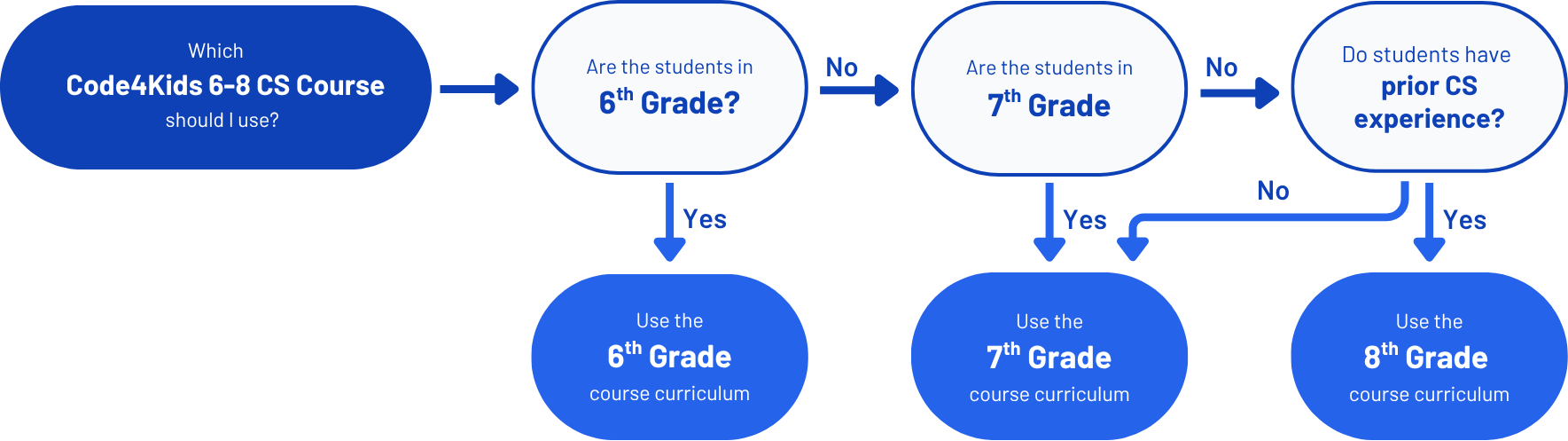
Concentrate on real-world applications of computer science, combining programming, data analysis, and cybersecurity in collaborative projects. Begin where your students are, whether continuing from earlier courses or starting new - the sequence is adaptable to support steady growth in skills and confidence.
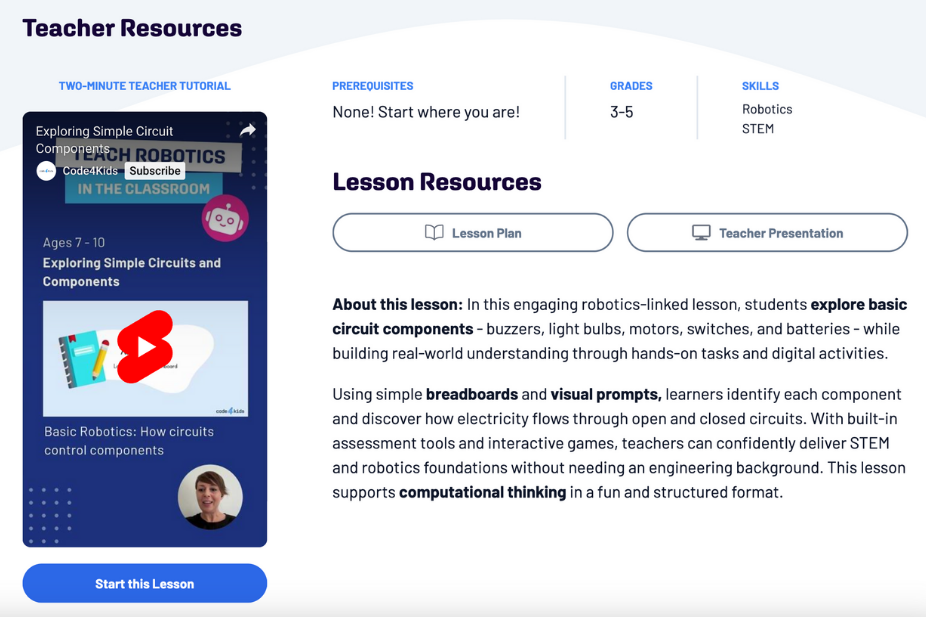

At Code4Kids, we believe every district has its own story — shaped by its schools, staffing models, community priorities, and the opportunities and challenges unique to its region. The Louisiana K–12 Computer Science Standards, adopted by BESE in 2024, set a clear vision for equitable access, digital literacy, and future-ready skills. But meeting those goals takes more than a one-size-fits-all approach.
Built for Louisiana’s Standards
Our curriculum is built for Louisiana’s context. It goes beyond simply aligning to the five Core Concepts, seven Core Practices, and their related sub-concepts — it creates a cohesive pathway from Lower Elementary (K–2) through Middle School (6–8) that adapts to your district’s starting point.
Custom Pathways for Every District
Before any rollout, we work alongside district leaders and teachers to understand your current CS offerings, available resources, and community goals. Whether your priority is expanding access in rural schools, addressing teacher shortages, or building on existing STEM initiatives, we co-create an implementation plan that fits your schedules, staffing, and budget.
Continuous Support for Lasting Success
Our support is continuous. Onboarding includes personalized and group training, followed by unlimited coaching, regular check-ins, and fast response when needs change. Quarterly reports translate usage and student progress into actionable insights — helping you track growth, address gaps, and celebrate success.
We’re not just a vendor. We’re a long-term partner committed to helping every Louisiana student thrive in computer science, from their first block of code to the complex projects they create in middle school.
.png)
Every district is different, so our first step is a collaborative conversation to understand your goals, challenges, and current Computer Science programs.
During this process, we will develop:
Once we’re on board, we kick off your first phase of implementation - smoothly and strategically.
We provide regular updates that celebrate progress and impact. This includes the following:
Technology moves fast. We help your district stay ahead. We achieve this by:


.svg)



.png)









.png)

.png)


.png)